
Trigger Press Speeds: Control, Movement, Precision
A Practical Guide to Faster, Smarter Shooting

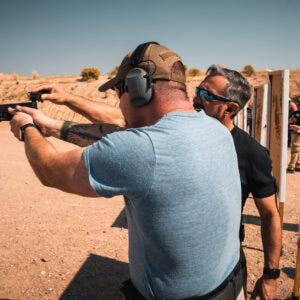
Shooting is often described as a science of precision balanced with the art of timing. Whether on the range, on the streets or in competition, mastering the trigger press, the act of engaging the trigger with the correct speed and control, determines not only how quickly a shooter can engage a target but also how precisely that round lands. One of the most effective frameworks for understanding and practicing trigger control involves three deliberate trigger press speeds: full speed, half speed, and slow speed.
These speeds do more than dictate how fast the trigger moves; they reflect the shooter’s mental discipline, awareness of target size, and intentional control of moment-to-moment precision. The ability to vary trigger speed seamlessly across situations reveals a shooter who not only understands movement but also mastering the fine calibration of precision.
The Philosophy Behind Speed and Precision
Every shot exists at the intersection of motion and moment. Too much motion, and precision collapses. Too much fixation on the moment, and motion becomes hesitant. The art of shooting is learning when to let movement dominate and when to prioritize stillness.
Trigger speed plays a central role in this balancing act. It’s not simply a measure of mechanical tempo; it’s a language of intent. How you press the trigger communicates what you perceive about the environment, the target, and your own readiness.
Full speed embodies decisiveness and confidence.
Half speed represents caution balanced with control.
Slow speed expresses deep focus, restraint, and surgical precision.
Learning to shift between these speeds fluidly is what transforms a marksman into a true practical precision shooter.
Full Speed: Quick, Large Targets
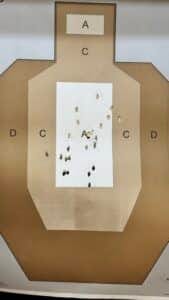
Full-speed trigger press is the equivalent of saying, “I know this shot.” It’s used when engaging large targets at close distances, where the margin for error is wider and the requirement for pinpoint accuracy is lower.
In these scenarios, the key skill is economy of movement, pressing the trigger as fast as possible with minimal disruption to the sight picture. The shooter’s body already knows the target zone, and the speed reflects trust in muscle memory and visual confirmation.
Think of full-speed trigger work as an extension of reflex. It’s controlled aggression; an assertive movement that conveys certainty. The full-speed trigger press demands total synchronization between visual input and motor response. There’s no pause, no overthinking. You’re letting the subconscious run the show.
Training Application:
To build a reliable full-speed trigger press, shooters must train to maintain sight stability even during rapid motion. The key isn’t just pressing fast; it’s pressing cleanly. Dry-fire drills focusing on rapid engagement while keeping the sights from lifting or dipping build the neural pathways necessary for clean speed.
Philosophical Insight:
Full speed isn’t reckless. It’s trust embodied. You’ve done the repetitions, you’ve ingrained the movement. Now, your body executes without interference from hesitation. In that sense, full speed expresses confidence in motion, a fluent statement that movement itself can be precise when practiced.
Half Speed: Careful, Medium Targets
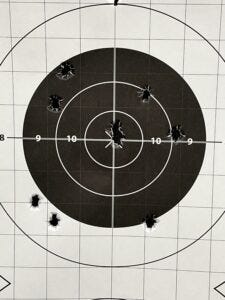
Half speed represents the transitional space between reflex and deliberation. It’s the mode of shooting where you’re aware of both the need for speed and the need for precision. The targets may be medium-sized or at intermediate distances, demanding a trigger press that’s smooth, not rushed, deliberate, but not slow.
At half speed, you’re thinking and feeling at once. The trigger moves with conscious awareness, yet it’s still continuous, no stops, no jerks. The goal is to maintain flow under control.
This is often where a shooter’s discipline truly shows. Many can shoot fast or slow, but maintaining a consistent half-speed rhythm requires mastery over self-regulation, knowing how to modulate intensity without losing flow.
Training Application:
Half-speed drills should emphasize timing and smoothness. The shooter should practice applying pressure through the trigger’s travel with a constant pace, paying attention to break timing and follow-through. Video analysis can help identify micro-pauses or inconsistencies.
A useful mental cue is to imagine a metronome. Your finger moves in rhythm, not haste. This balance of control and motion trains the mind to make minor adjustments on the fly, maintaining both awareness and continuity.
Philosophical Insight:
Half speed mirrors life under pressure, the point where instinct meets judgment. It teaches patience within action and precision within pace. The half-speed press isn’t about doing less; it’s about doing enough with awareness. You’re not reacting, you’re responding.
Slow Speed: Precise, Small Targets
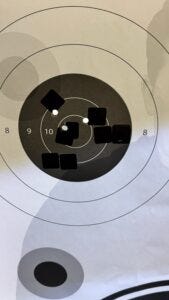
Slow-speed trigger press is where technical precision meets mental stillness. It’s used for small targets, long distances, or high-stakes shots, any situation where the slightest movement can translate into a miss.
Here, every fraction of a second counts because every movement matters. The shooter’s breath, heartbeat, and trigger finger all converge into one singular moment of control. Slow speed doesn’t mean hesitance; it means intentional precision.
The slow press allows for the cleanest possible trigger break. The finger applies pressure incrementally, letting the shot surprise the shooter in the purest sense of marksmanship tradition.
Training Application:
Slow-speed training emphasizes isolation and awareness. Shooters often practice slow-fire drills at extended distances, focusing on breaking the shot without disturbing the sights even a hair’s width. This develops deep tactile sensitivity, learning exactly how much pressure initiates movement and how much completes it.
Dry fire at slow speed is especially valuable for imprinting proper trigger discipline. The goal is to build predictable precision, training both nerves and muscles to work in unison with visual feedback.
Philosophical Insight:
Slow speed is the art of stillness within movement. It’s where the shooter learns that precision is not about freezing; it’s about harmonizing micro-movements until they dissolve into intention. At slow speed, each trigger press becomes a meditation, a statement that control is power.
Integrating Speed and Precision
Mastering the three trigger speeds isn’t just about learning when to shoot fast or slow. It’s about developing dynamic adaptability, the ability to adjust your tempo instinctively based on your visual data and target feedback.
Each speed builds a distinct layer of awareness:
Full speed trains confidence and reaction.
Half speed builds consistency and control.
Slow speed develops precision and patience.
Together, they create a complete language of trigger control. The shooter who can fluidly shift between these speeds becomes capable of expressing movement through precision and precision through movement.
Drill Integration Example:
A progressive shooting drill can start with a large target at full speed, transition to a medium target at half speed, and finish with a small target at slow speed, all in one continuous string of fire. I recommend our Pistol Standard Whiskey 2 as a perfect option. This standard and topic teaches the shooter to calibrate tempo based on feedback, building intuitive awareness.
Over time, this practice trains the subconscious to interpret visual stability as the cue for trigger speed, faster when the sight picture is broad and stable, slower when it’s fine and critical.
The Precision of Moment
Ultimately, trigger press speed is not merely a mechanical choice, it’s an expression of awareness. Each level of speed represents a dialogue between movement and precision, between moment and intention.
Shooting at full speed is about trusting your training. Shooting at half speed is about balancing thought and flow. Shooting at slow speed is about honoring precision itself.
When you master all three, your trigger finger no longer just reacts; it communicates. Each trigger press becomes a statement of understanding, that precision is not found in the absence of movement, but in the mastery of it.